
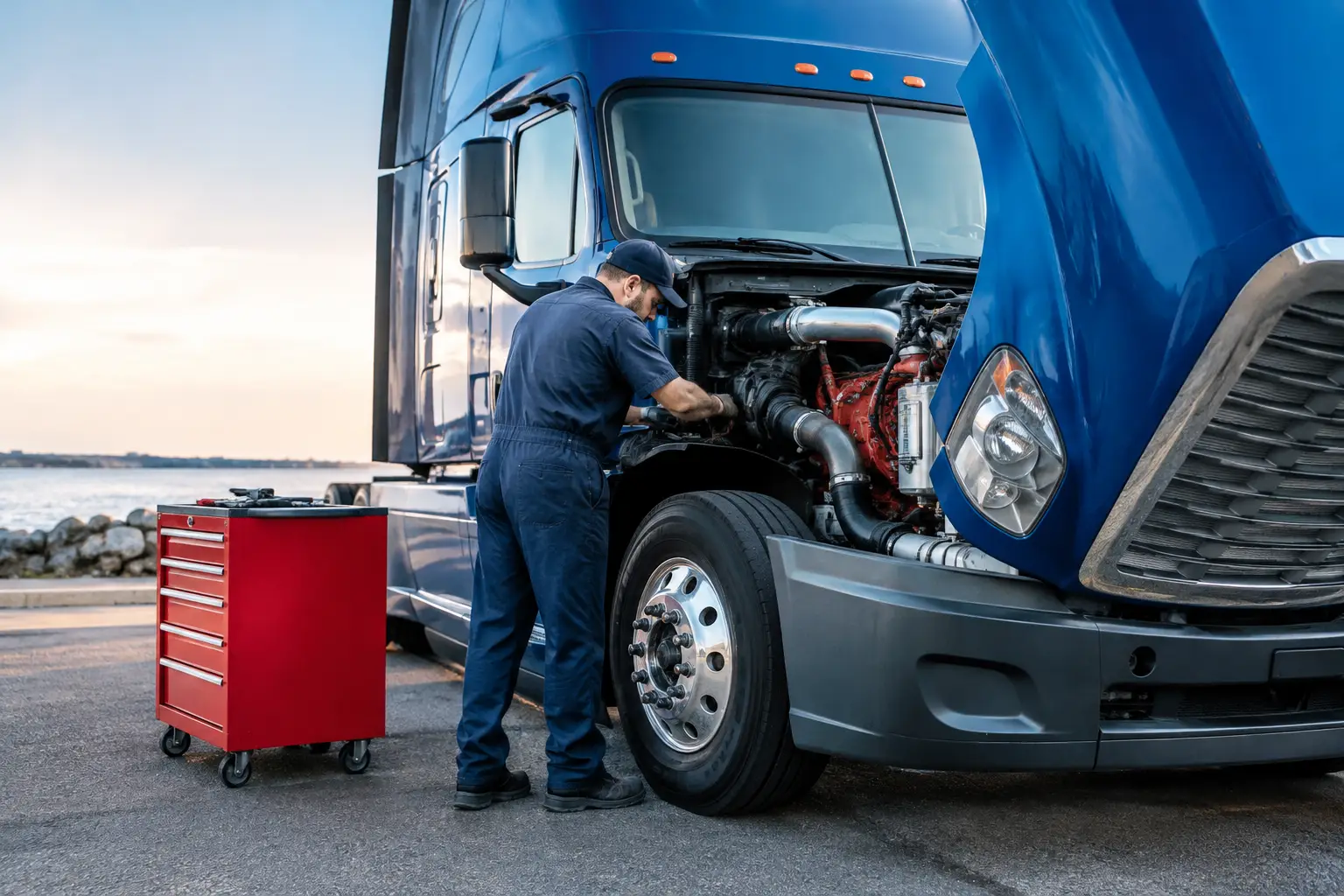
A truck sitting on the shoulder, at a customer site, or in a loading yard is not just a repair problem. It is a missed delivery window, an idle driver, a dispatcher reshuffling routes, and revenue that stops moving. When you need semi truck repair Nassau County, the right response is not always a tow and a long wait for a shop bay. A qualified heavy-duty mobile mechanic can bring diagnostics, repair capability, and clear communication directly to the truck.
For owner-operators and fleet managers across Nassau County, the priority is simple: identify the fault accurately, make a dependable repair, and get the equipment road-ready without creating more downtime than necessary.
Why Mobile Semi Truck Repair Matters in Nassau County
Nassau County commercial traffic does not leave much room for a mechanical delay. Trucks and trailers move through congested roads, distribution points, construction sites, industrial properties, and customer locations where timing matters. A no-start condition, air leak, overheating issue, brake concern, or electrical fault can turn a normal workday into a costly disruption fast.
Mobile heavy-duty repair reduces the steps between breakdown and recovery. Instead of arranging a tow, getting the truck into a queue, and waiting for a shop to inspect it, a technician comes to the vehicle. That can make a major difference when the repair can be completed safely on site.
It does depend on the failure. Severe engine damage, an internal transmission failure, or a repair requiring specialized shop equipment may still call for a controlled shop repair or rebuild. But many common breakdowns can be diagnosed and addressed where the truck is parked, at the roadside, or at your yard. The important part is getting an experienced technician involved early enough to make the right call.
Problems That Need Fast Heavy-Duty Attention
Commercial trucks give warning signs before some failures, but not every issue gives a driver much notice. A loss of power under load, warning light, rising coolant temperature, repeated air loss, hard shifting, or a truck that will not crank should be treated as an operational decision, not something to keep running until the next stop.
Continuing to drive can turn a manageable repair into a much larger one. A small coolant leak can become an overheating event. A weak starter can leave a truck stranded at a delivery location. An air system problem can affect braking performance and place the vehicle out of service. A transmission concern that is ignored can lead to more extensive internal damage.
A proper service call starts with clear information. Drivers and dispatchers should be prepared to share the truck location, unit number, make and model, engine details if available, fault codes, symptoms, and whether the truck is loaded. That information helps the technician arrive prepared and gives your operation a better chance of a first-visit repair.
Engine and Electrical Diagnostics
Modern diesel trucks depend on accurate diagnostics. A dash warning light may point to a sensor, but the actual cause can involve wiring, fuel delivery, emissions components, air intake issues, or another system affecting engine performance. Replacing parts based only on a code can waste time and money.
Heavy-duty diagnostics should combine scan data with hands-on testing. A technician needs to evaluate what the truck is doing, inspect related components, verify electrical signals where needed, and confirm the repair before releasing the vehicle. That approach matters when the truck is needed for the next dispatch, not just cleared long enough to leave a parking lot.
Electrical problems also deserve quick attention. Corroded connections, damaged wiring, battery issues, charging-system failures, and lighting faults can cause no-start conditions or compliance concerns. On a working truck, electrical reliability is not a convenience. It supports safe operation, communication, lighting, and engine performance.
Air, Brake, and Trailer Repairs
Air system issues demand immediate attention because they can affect brake operation and put equipment out of service. Leaking air lines, damaged fittings, faulty valves, compressor problems, and brake-related concerns should be inspected by a heavy-duty professional before the truck returns to the road.
Trailer failures can be just as disruptive as tractor problems. A trailer with lighting faults, air leaks, suspension concerns, brake issues, landing gear damage, or door problems can delay the entire load. Keeping a tractor ready does not help if the trailer cannot move safely or legally.
For fleets running mixed equipment, it helps to work with a service provider that understands both sides of the combination. That keeps communication simple and avoids losing another day coordinating separate repair calls.
Choosing Semi Truck Repair in Nassau County
The cheapest initial estimate is not always the lowest-cost repair. For commercial equipment, the real cost includes downtime, missed appointments, towing, driver hours, emergency rescheduling, and the chance that an incomplete repair creates another breakdown. Look for a provider that communicates what they found, what repair is recommended, what parts are needed, and whether the truck can safely operate before the full repair is completed.
Experience with heavy-duty systems matters. Semi-trucks are not oversized passenger vehicles. Their engines, aftertreatment systems, air brakes, electrical networks, transmissions, trailers, and duty cycles require commercial-level knowledge. A technician should understand how the vehicle is used and what a repair decision means for a loaded truck on an active route.
Response also matters, especially when the equipment is blocking a job, sitting at a receiver, or stranded roadside. Fleet Command LLC provides mobile heavy-duty service built around getting experienced technicians to commercial vehicles and helping operators make practical next-step decisions. The goal is straightforward: repair what can be repaired on site, explain what requires further work, and keep the fleet moving whenever it is safe to do so.
Preventive Maintenance Is Downtime Control
Emergency road service is essential, but the most productive repair call is often the one scheduled before a failure occurs. Preventive maintenance gives technicians an opportunity to find developing problems while the truck is still operating on your schedule.
A strong maintenance plan should account for mileage, engine hours, load type, routes, idle time, and the age of the equipment. A local delivery truck that makes frequent stops can wear differently than a highway tractor running long miles. There is no one maintenance interval that fits every operation.
During scheduled service, a heavy-duty technician can inspect fluid levels and condition, belts and hoses, batteries and charging performance, air-system components, brakes, tires, lighting, suspension, and visible leaks. Engine and transmission concerns can also be addressed before they become a roadside event. For fleets, documenting these inspections helps identify repeat issues across units and makes maintenance budgeting more predictable.
Preventive work is not about replacing parts without reason. It is about catching wear at the point where a planned repair is less expensive and less disruptive than a breakdown. That distinction protects both your equipment budget and your customer commitments.
What to Do When a Truck Goes Down
First, protect the driver and the scene. Move to a safe location when possible, use required warning devices, and follow company safety procedures. If the truck cannot be moved safely, do not force it.
Next, get a clear description of the problem before placing the service call. Note warning lights, fault messages, unusual sounds, leaks, smoke, loss of power, air-pressure readings, and whether the unit is loaded. Photos and videos can help when they can be taken safely.
Finally, avoid guessing at repairs or authorizing parts without a diagnosis. A fast repair is valuable, but a correct repair is what keeps the truck from returning to the shoulder a few miles later. Ask for a plain explanation of the findings, the repair path, and any follow-up maintenance the unit needs.
When a commercial vehicle is down in Nassau County, speed matters, but so does workmanship. Keep your unit information accessible, address warning signs early, and have a dependable heavy-duty service partner ready before the next breakdown decides your schedule for you.